
Apodizing Mask
by Ken Florentino,
kflor@comcast.net
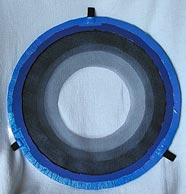
Many people have seen me use a home-built apodizing mask while observing planets and have inquired about its use and design. An apodizing mask (I sometimes call it my “60’s filter”) is used to cut through the seeing much like an aperture stop. Technically, it is supposed to approximate a gaussian curve for the aperture instead of the sharp edge of the normal scope. In a refractor, it basically removes the first diffraction ring of the airy disk at the expense of fattening the central part of the disk somewhat. In an obstructed design like a Newtonian or SCT, there is some debate about it’s value. Also, the larger the secondary’s obstruction, the less it helps. It isn’t very useful in a scope smaller than 8 inches. For my scope (reflector) and my eyes, it seems to help on those less than perfect nights of seeing. Another “side effect” that it makes is a rainbow pattern around the object–hence “60’s filter” (psychedelic man)! The bottom line is that it helps see detail on planets and split double stars. Continue reading A Do-It-Yourself Apodizing Mask

Servo Focuser
by Steve Bygren,
steve2822@earthlink.net
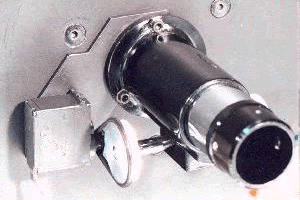
In the January, 1996 issue of Sky & Telescope, my picture showed up with a “servo focuser” gizmo that a member of my astronomy club (Ken Florentino) created. Since that time, several people have contacted me asking for details on how to get one working. A description follows… Continue reading How to Build a Servo Focuser
or When A Bargain Isn’t Necessarily A Bargain
by Steve Bygren, steve2822@earthlink.net
In the spring of 1991, I decided to build my own poncet table for my 10 inch dobsonian. I had recently read a number of articles on poncet tables, and I figured I couldn’t live without one. I decided to build my own because they are relatively straight forward to construct, and the commercial versions cost nearly three times what my telescope cost me to build. Continue reading How To Build Your Own Poncet Table In Only 18 Months

Leonid Meteor Shower
by Lou (Dex) Dextraze,
meteor1138@earthlink.net
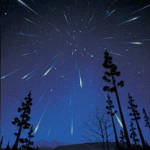
What?…listening for meteors? Why not!
Got a short-wave radio? Or an AM/FM with a short-wave band you ignore most of the time?
Good. Tune the short-wave to a weak and distant station. Try to stay above 15 megahertz (MHz). Keep the volume real low. Now, when a meteor comes barreling into our atmosphere and becomes visible, usually between 80 and down to 25 miles or so, it will ionize the air along its flight path.
This very temporary “reflector” of radio waves should cause the volume of the station’s signal to rise sharply with even the possibility of Doppler change in pitch to occur. Give it a try and let me know of your success or ongoing trials.